
If part of your yard turns to mud after every storm, stays wet for days, or has grass that just will not grow no matter what you do, the problem is almost always water that has nowhere to go. In the Charlotte area, that comes down to a few predictable causes — and the fix depends on which one you have.
Why Piedmont yards hold water
Our region sits on heavy red clay. Clay drains slowly under the best conditions, and construction makes it worse: grading equipment compacts the soil around a new home, and the topsoil that would normally absorb rainfall is often thin or missing. Add the intense, short-duration thunderstorms that define our summers and water sheets across the surface instead of soaking in.
On top of that, two things concentrate water in the wrong places: grading that slopes toward the house or toward a low pocket in the yard, and downspouts that dump roof runoff — hundreds of gallons in a single storm — right at the foundation.
Diagnose it first
Walk the yard during and just after the next hard rain and note:
- Where water collects, how deep it gets, and how many days it takes to disappear
- Whether any of that water is sitting within ten feet of the foundation
- Where your downspouts discharge, and whether the ground there is always the wettest spot
- Whether the lawn slopes toward the house anywhere along its perimeter
The answers point to the fix. Water pooling far from the house in a single low spot is a classic French drain candidate. Water at the foundation from downspouts might only need buried downspout extensions carrying it out to daylight. A broad area that sheets water may need regrading rather than a drain.
What a French drain actually is
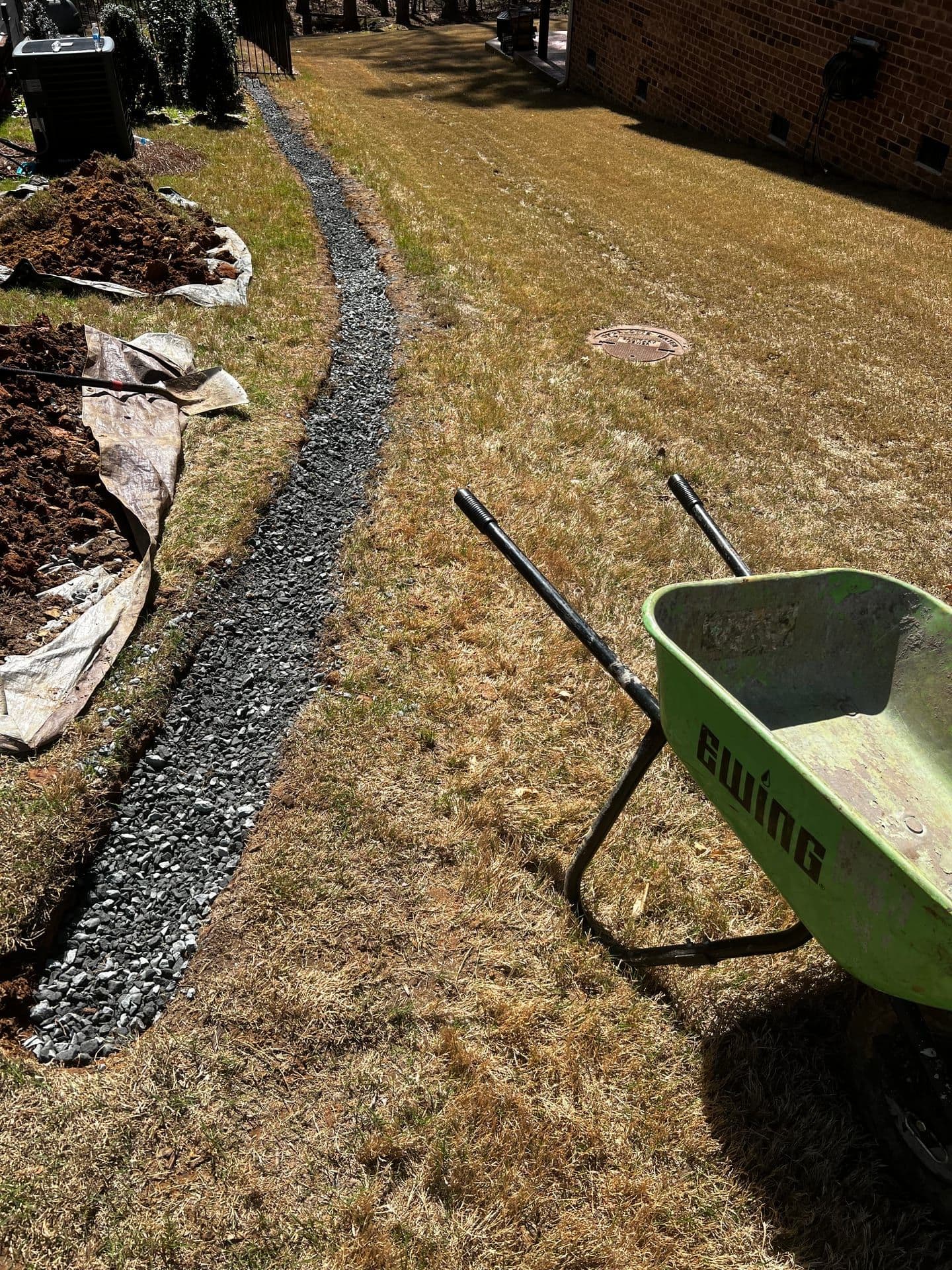
A French drain is a gravel-filled trench with a perforated pipe at the bottom that collects water and carries it to a lower outlet — the street, a storm drain, a dry well, or a spot where it can safely spread out. Done properly it includes a filter fabric wrapping the gravel so soil does not clog the system over time, a consistent slope toward the outlet, and a real discharge point. A trench that just holds water with nowhere to send it is not a French drain; it is a hole.
The installation is straightforward for an experienced crew: mark utilities, excavate the trench to grade, lay fabric and gravel, set the pipe, backfill, and restore the surface with topsoil and sod so the finished result blends into the lawn.
When a French drain is the right call — and when it is not
A French drain is the right solution when you have a persistent wet area or subsurface water that needs to be intercepted and relocated. It is often not the cheapest fix for these situations:
- Downspouts flooding the foundation → buried solid-pipe extensions to daylight are simpler and cheaper
- A broad slope draining toward the house → regrading the first several feet away from the foundation
- A seasonal low spot you want to keep natural → a dry creek bed can move surface water and look intentional
Why standing water near the foundation is urgent
Cosmetic wet spots in the middle of the yard can wait. Water sitting against the foundation cannot. Over time it works into footings and crawl spaces, causes settlement and cracking, and creates the conditions for mold and wood rot. Drainage corrections are inexpensive compared to foundation repair, and the gap only grows the longer the water keeps working.
We design and install French drains, downspout systems, and regrading for yards across Charlotte, Fort Mill, and Lake Wylie, and we will tell you honestly which one your situation actually needs. Call (704) 615-9773 or request a free quote and we will assess it after the next rain.